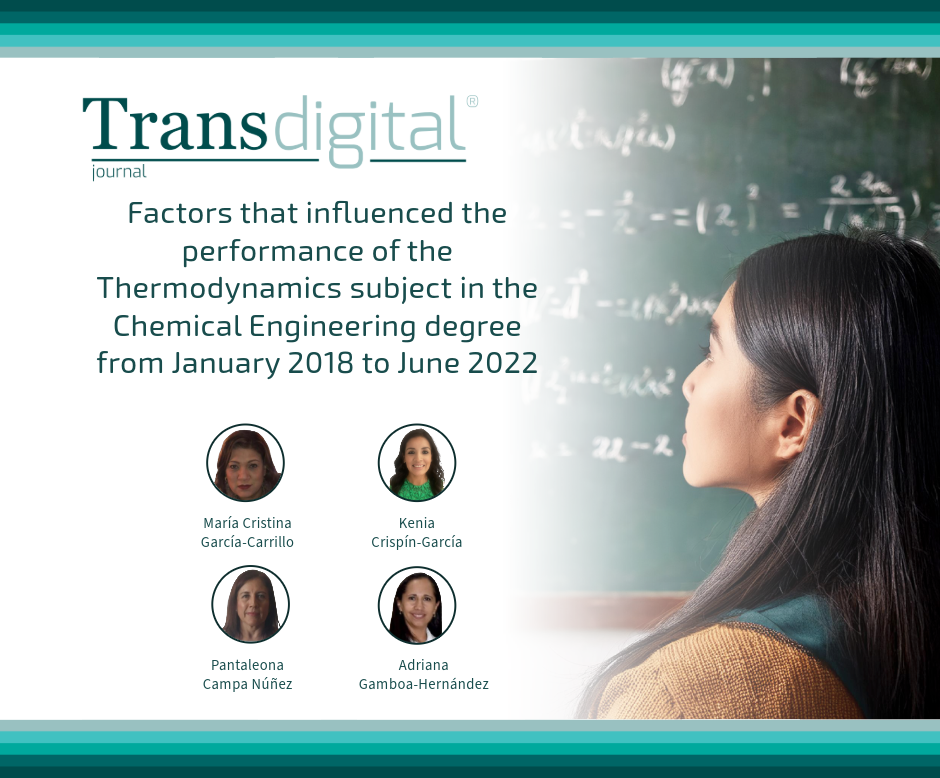
Factors that influenced the performance of the Thermodynamics subject in the Chemical Engineering degree from January 2018 to June 2022
DOI:
https://doi.org/10.56162/transdigital383Keywords:
failure, index, thermodynamics, calculus, chemistryAbstract
Failure is an indicator of students' academic performance. It is important to analyze it, since it is related to school dropout. Specifically, it was detected that the failure rate in the subject of Thermodynamics, from the Chemical Engineering curriculum of the Technological Institute of La Laguna, Mexico, grew between 2018 and 2022. This subject is key for the career, since it relates to various subjects throughout the curriculum. This research found that for every 100 students, 43 fail the subject. This generates a considerable gap in the student population. Furthermore, failure is related to various factors such as lack of knowledge in basic sciences and the teaching-learning methods used by the teacher. This study helps institutions generate strategies to improve school career indicators and increase the terminal efficiency of the Chemical Engineering curriculum.
References
Amado Moreno, M. G., García Velázquez, Á., Brito Páez, R. A., Sánchez Luján, B. I., & Sagaste Bernal, C. A. (2014). Causas de reprobación en ingeniería desde la perspectiva del académico y administradores. Ciencia y Tecnología, 14, 233-250.
Barbosa Saldaña, J. G., Gutiérrez Torres, C. D., & Jiménez Bernal, J. A. (2015). Termodinámica para ingenieros. Grupo Editorial Patria.
Barroso-Tanoira, F. G. (2014). Motivos para la baja voluntaria definitiva de alumnos de licenciatura en instituciones de educación superior privadas. Un estudio en el sureste de México. Revista Iberoamericana de Educación Superior, 5(14), 19-40.
Rochin Berumen, F. L. (2021). Deserción escolar en la educación superior en México: revisión de literatura. RIDE Revista Iberoamericana para la Investigación y el Desarrollo Educativo, 11(22). https://doi.org/10.23913/ride.v11i22.821
Cabañas, B. C. (2018). Factores pedagógicos que inciden en la reprobación, en voz de los estudiantes normalistas. Interconectando Saberes, (6), 127–147. https://doi.org/10.25009/is.v0i6.2584
Christle, C. A., Jolivette, K., & Nelson, M. (2007). School characteristics related to high school dropout rates. Remedial and Special Education, 28(6), 325–339. https://doi.org/10.1177/07419325070280060201
CEPAL. (2021). El impacto social de la pandemia en América Latina. Claves de la CEPAL para el desarrollo: Panorama Social de América Latina 2020, 8. https://www.cepal.org/sites/default/files/publication/files/46740/S2000182_es.pdf
Paramo, G. J., & Correa Maya, C. A. (2012). Deserción estudiantil universitaria. Conceptualización. Revista Universidad EAFIT, 35(114), 65–78. https://publicaciones.eafit.edu.co/index.php/revista-universidad-eafit/article/view/1075
Peralta Castro, R., & Mora Rodríguez, J. (2014). Diseño de estrategias para disminuir los índices de deserción de los beneficiarios de crédito educativo en tres países de América [Sesión de congreso]. 2014: Congreso CLABES IV, Medellin, Colombia. https://revistas.utp.ac.pa/index.php/clabes/article/view/990
Pérez Cardoso, C. N., Cerón Mendoza, E. A., Suárez Mella, R. P., Mera Martínez, M. E., Briones Bermeo, N. P., Zambrano Loor, L. Y., & Barreto Rosado, M. E. (2019). Deserción y repitencia en estudiantes de la carrera de Enfermería matriculados en el período 2010-2015. Educación Médica, 20(2), 84-90.
Tinto, V. (1989). Definir la deserción: una cuestión de perspectiva. Revista de educación superior, 71, 1-9.
Vries, W., León Arenas, P., Romero Muñoz, J. F., & Hernández Saldaña, I. (2011). ¿Desertores o decepcionados? Distintas causas para abandonar los estudios universitarios. Revista de la Educación Superior, 40(160), 29-49.
Downloads
Autor de correspondencia
El autor de correspodencia se identifica con el siguiente símbolo: *Published
How to Cite
License
Copyright (c) 2024 María Cristina García Carrillo, Kenia Crispín García, Pantaleona Campa Núñez, Adriana Gamboa Hernández

This work is licensed under a Creative Commons Attribution 4.0 International License.
All articles in Transdigital are licensed under a Creative Commons Attribution 4.0 International License. Authors hold the copyright and retain publishing rights without restrictions.





