A quantitative study
A quantitative study
DOI:
https://doi.org/10.56162/transdigital608Keywords:
critical thinking, problem-solving, higher education, cognitive skills, university studentsAbstract
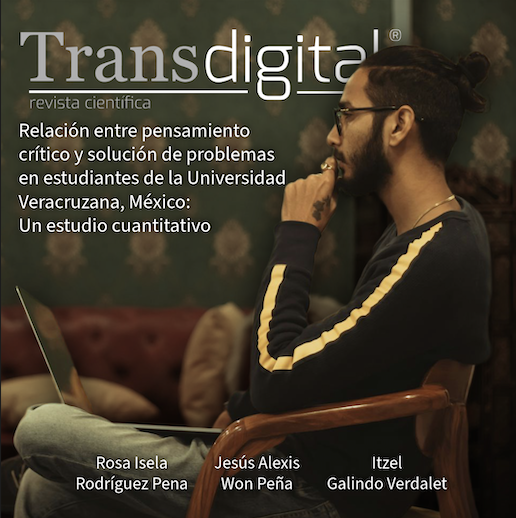
This study analyzed the relationship between critical thinking and problem-solving skills in students from the Veracruz region of the Universidad Veracruzana, Mexico. It was conducted with a quantitative approach with a non-experimental, cross-sectional, and correlational design. The sample consisted of 140 students from various academic disciplines. Data was collected using a structured questionnaire of 36 items, organized into dimensions of critical thinking (analysis, inference, and evaluation) and problem-solving (problem identification, alternative generation, and decision-making), using a Likert-type scale. The results showed that both variables were at a moderate level, with a mean of 3.67 for critical thinking and 3.59 for problem-solving. Furthermore, a strong positive correlation was identified between the two competencies (r = .83, p < .01), demonstrating a significant relationship between them. In conclusion, critical thinking emerges as a key factor in the development of problem-solving skills in university students. These findings suggest the need to strengthen pedagogical strategies aimed at developing higher-order cognitive skills, contributing to the improvement of academic training and professional performance in complex contexts.
References
Bezanilla, M. J., Fernández-Nogueira, D., Poblete, M., & Galindo-Domínguez, H. (2021). Methodologies for teaching-learning critical thinking in higher education: The teacher’s view. Thinking Skills and Creativity, 33(9), 100584.
BID. (2021). Habilidades del siglo XXI en América Latina y el Caribe. Banco Interamericano de Desarrollo. http://dx.doi.org/10.18235/0003343
Chacón-Cueva, J. J., Duran-Llaro, K. L., Chacón-Cueva, G. M., & Bustamante-Castrejón, D. C. (2023). Aprendizaje basado en problemas para desarrollar el pensamiento crítico en estudiantes de secundaria. Revista Arbitrada Interdisciplinaria Koinonía, 8(Supl. 2), 350–370. https://doi.org/10.35381/r.k.v8i2.2880
Dinsmore, D. L., Alexander, P. A., & Loughlin, S. M. (2021). Focusing the conceptual lens on metacognition, self-regulation, and self-regulated learning. Educational Psychology Review, 20(4), 391-409.
Hernández-Sampieri, R., Fernández-Collado, C., & Baptista-Lucio, P. (2021). Metodología de la investigación (7.ª ed.). McGraw-Hill.
OECD. (2022). Education at a Glance 2022. Página web oficial de la Organisation for Economic Co-operation and Development. https://www.oecd.org/en/publications/education-at-a-glance-2022_3197152b-en.html
OECD. (2023). OECD Skills Outlook 2023: Skills for a Resilient Green and Digital Transition. Página web oficial de la Organisation for Economic Co-operation and Development. https://www.oecd.org/en/publications/oecd-skills-outlook-2023_27452f29-en.html
Paul, R., & Elder, L. (2020). The miniature guide to critical thinking concepts and tools (8th ed.). Foundation for Critical Thinking. https://www.criticalthinking.org/files/Concepts_Tools.pdf
Pineda Caro, D. Y. (2022). Educación STEAM en contextos universitarios: retos y oportunidades. Revista Latinoamericana de Tecnología Educativa, 3(1), 229-244.
Saiz Sánchez, C., & Fernández Rivas, S. (2012). Pensamiento crítico y aprendizaje basado en problemas cotidianos. REDU. Revista de Docencia Universitaria, 10(3), 325–346. https://doi.org/10.4995/redu.2012.6026
Schunk, D. H., & Zimmerman, B. J. (2011). Handbook of Self-Regulation of Learning and Performance. Routledge. https://doi.org/10.4324/9780203839010
Tavakol, M., & Dennick, R. (2021). Making sense of Cronbach’s alpha. International Journal of Medical Education, 12, 53–55.
UNESCO. (2021). Reimaginar juntos nuestros futuros: Un nuevo contrato social para la educación. Organización de las Naciones Unidas para la Educación, la Ciencia y la Cultura. https://doi.org/10.54675/ASRB4722
UNESCO. (2022). Transforming education from within: Current trends in learning and teaching for the future. Organización de las Naciones Unidas para la Educación, la Ciencia y la Cultura. https://unesdoc.unesco.org/ark:/48223/pf0000383002
Downloads
Autor de correspondencia
El autor de correspodencia se identifica con el siguiente símbolo: *Published
How to Cite
License
Copyright (c) 2026 Rosa Isela Rodríguez Pena, Jesús Alexis Won Peña, Itzel Galindo Verdalet

This work is licensed under a Creative Commons Attribution 4.0 International License.
All articles in Transdigital are licensed under a Creative Commons Attribution 4.0 International License. Authors hold the copyright and retain publishing rights without restrictions.





