
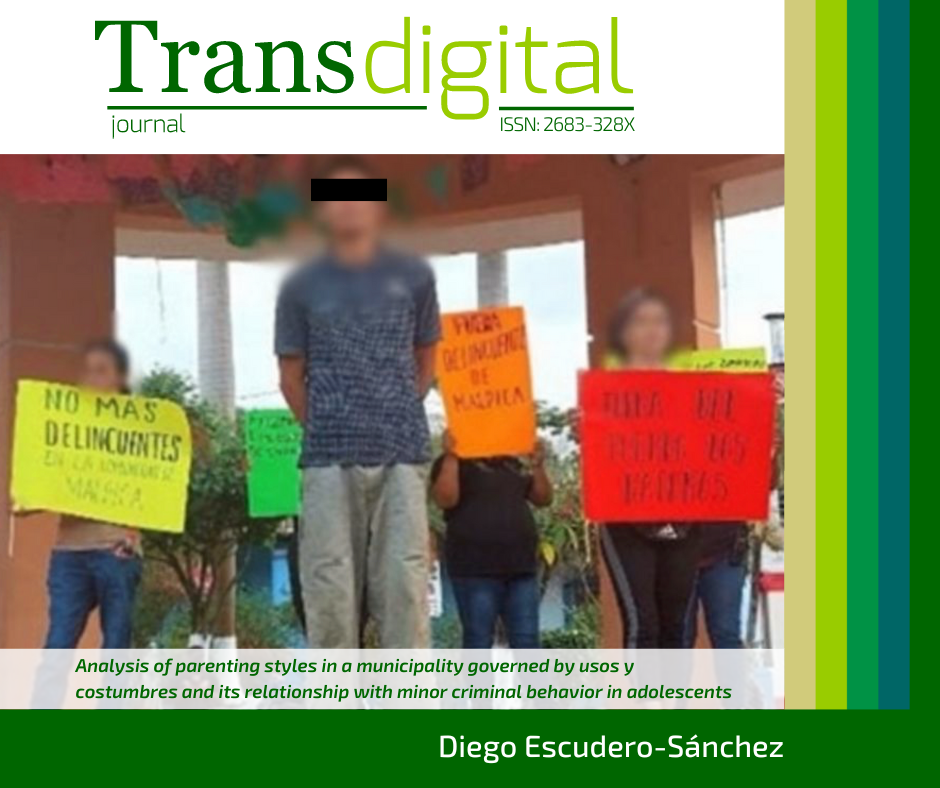
Analysis of parenting styles in a municipality governed by usos y costumbres and its relationship with minor criminal behavior in adolescents
DOI:
https://doi.org/10.56162/transdigital175Keywords:
Parenting stiles, municipality governed by usos y costumbres, minor criminal, adolescents, qualitative researchAbstract
Crime rates in Mexico are a constantly growing problem. For this reason, they are usually approached by multidisciplinary studies, among which forensic psychology stands out, which provides valuable theoretical frameworks that try to explain the role of identity, social relationships, and parenting styles of offenders. However, all these studies have concentrated more on urban societies. The municipalities governed by usos y costumbres, which in Oaxaca, Mexico, reach approximately 80%, have not received the same attention from the scientific community. Theoretically, these community organization systems are based on strong native identities, close social relationships, and traditional parenting styles. Therefore, an investigation was carried out with a qualitative and exploratory approach to identify the parenting styles received by three young delinquents from the municipality of San Lorenzo Cacaotepec, Oaxaca, Mexico, who committed minor offenses in this municipality. The main findings suggest that, contrary to assumptions, communication channels between family members are scarce, there is an absence of one of the parents, and groups outside the family, such as sports teams, are risk factors to ingest prohibited substances. This suggests that the municipalities that are governed by usos y costumbres maintain a sense of community and tradition with political effects, but not family or personal ones. In this sense, there would be no reason to consider that fewer petty crimes are committed in these communities than in urbanized societies.
References
APA. (2017). Estilos de Crianza. https://www.apa.org/act/resources/espanol/crianza
Canedo, G. (2008). Una conquista indígena Reconocimiento de municipios por “usos y costumbres” en Oaxaca (México). Red de Bibliotecas Virtuales de Ciencias Sociales de América Latina y El Caribe de La Red CLACSO. http://biblioteca.clacso.edu.ar/ar/libros/clacso/crop/cimada/Vasquez.pdf
Córdoba, J. (2014). Estilos de crianza vinculados a comportamientos problematicos de niñas, niños y adolescentes [Tesid en Maestría de Salud Mental de la Universidad Nacional de Córdoba, Argentina]. http://lildbi.fcm.unc.edu.ar/lildbi/tesis/cordoba_julia.pdf
Data México. (2020). San Lorenzo. https://datamexico.org/es/profile/geo/san-lorenzo-cacaotepec
Given, L. (Ed.). (2008). The SAGE Encyclopedia of Qualitative Research Methods. SAGE Publications.
Herrera, P. (1999). Principales factores de riesgo psicológicos y sociales en el adolescente. Revista Cubana de Pediatría, 71(1). http://scielo.sld.cu/scielo.php?script=sci_arttext&pid=S0034-75311999000100006
INEGI. (2008). Clasificación mexicana de delitos 2008. http://www.diputados.gob.mx/documentos/Congreso_Nacional_Legislativo/Doc/CMD_Integrado.pdf
INEGI. (2019). Encuesta Nacional de Victimización y Percepción sobre Seguridad Pública 2019. https://www.inegi.org.mx/temas/incidencia/
Páramo, M. (2017). Factores de Riesgo y Factores de Protección en la Adolescencia: Análisis de Contenido a través de Grupos de Discusión. Terapia Psicológica, 29(1), 85-95. https://teps.cl/index.php/teps/article/view/166
Trujillo Mariel, P. R. L. (2007). La génesis de la conducta criminal y su impacto sociocultural. Comisión Nacional de los Derechos Humanos. https://archivos.juridicas.unam.mx/www/bjv/libros/11/5189/6.pdf
UNICEF. (2020). ¿Qué es la adolescencia? https://www.unicef.org/uruguay/que-es-la-adolescencia
Downloads
Autor de correspondencia
El autor de correspodencia se identifica con el siguiente símbolo: *Published
How to Cite
License
Copyright (c) 2022 Diego Escudero-Sanchez

This work is licensed under a Creative Commons Attribution 4.0 International License.
All articles in Transdigital are licensed under a Creative Commons Attribution 4.0 International License. Authors hold the copyright and retain publishing rights without restrictions.





